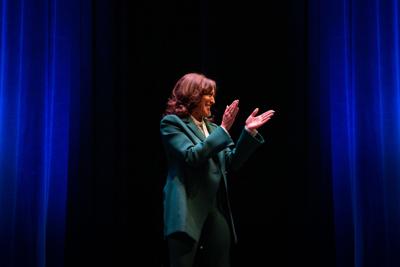

Dozens stood in line before the 6 p.m. door openings to get inside Ovens Auditorium and to their seats to see the former Vice President Kamala Harris take the stage for a conversation focused on the current political climate during her "107 Days" book tour.
Harris spoke on a wide variety of topics stemming from questions from the guest speaker, Brooklyn Decker, an actress and Charlotte native.
Cheers and claps erupted in the almost sold-out auditorium after almost every point Harris made, as she spoke on the war in Iran, expense inflation, the SAVE Act and more.
'This is a war of choice'
Early in the discussion, Harris addressed the ongoing conflict involving Iran, describing it as "a war of choice" and stating it was entered into by the current administration without a clear long-term strategy.
She continued to say that the conflict has placed U.S. service members at risk and that a dozen had been killed in duty.
Since the beginning of Operation Epic Fury, which was given its name by the U.S. defense secretary, Pete Hegseth, 13 U.S. service members have been killed and 381 have been wounded, as confirmed by U.S. Central Command.
Harris expanded on the international implications, citing her experience as the 49th vice president and her meetings with more than 150 world leaders during her term.
She said current U.S. foreign policy decisions have prompted uncertainty among allies about the country's global role.
"I can tell you that our allies are scratching their head at the very least, asking, 'Who is America and who are the people who are leading America right now?'" Harris said.
She added that relationships between nations depend on consistency and trust, and said those elements have been impacted in recent years.
"The strength of a relationship will be about mutual respect, trust [and] consistency," Harris said. "Our allies can't count on that right now from America."
Prices up, despite voters' beliefs
Harris also discussed inflation and the broader economic landscape, pointing to rising costs for everyday necessities such as groceries and gas.
Gas prices have recently jumped by over a dollar in price increase in just the last month.
At the end of March, the national average was $3.98; a month prior, the average was $2.98, but as of April 15, the national average is $4.10, and North Carolina's average is $3.86.
During President Donald Trump's address to the Economic Club of New York on Sept. 5, 2024, he claimed that his goal was to bring gas prices significantly down to under $2 a gallon.
Harris acknowledged that while some economic indicators suggest stability, many Americans continue to experience financial strain in their daily lives.
"There are so many who are not doing well, for a variety of reasons," Harris said, referencing conversations she has had with individuals across the country.
She described a visit with a single mother in Jackson, Mississippi, who detailed the challenges of supporting her family on a limited budget.
Harris said the woman carefully tracked grocery prices and often prioritized her children's needs over her own.
"At one point, I asked her, 'What's in the cart for you?'" Harris said. "And she said, 'I will eat whatever is left after they're done.'"
Harris used the example to highlight what she described as a disconnect between national economic messaging and lived experiences.
"She said to me, 'Why are they talking about the economy is doing so well? Don't they see?'" Harris said.
She also addressed voter expectations during the most recent election cycle, noting that some supported current leadership based on promises to lower costs.
"I do believe that there is a fair number of those that voted for him… because they believed him when he said he was going to bring down prices on day one," Harris said. "And he lied."
The SAVE Act
As midterms grow nearer on Nov. 3, Harris spoke about a bill that could produce broader changes to the voting process if passed by the House and Senate.
The SAVE Act, reintroduced by the Trump administration in early 2026, would require citizens to present either a birth certificate or a passport, proving their citizenship when voting at polling sites. A driver's license would not be accepted as valid documentation to prove identity and citizenship.
Currently, less than half of American citizens have a passport or can get one due to financial reasons or acess. Passports cost approximately $165-200 each for adults and $135 for children.
A standard driver's license, priced and administered by each state's Division of Motor Vehicles, ranges from $10-100. To obtain a driver's license, some states require the same or more information regarding proof of address and citizenship or legal presence as passport applications. In all 50 states, citizenship is not required to obtain a driver's license.
Harris said that millions of Americans do not possess passports and described complications for individuals, such as married women, whose legal documentation may not align with their current identification. Married women with outdated documents would need to present a marriage certificate in addition to a passport or birth certificate under the proposed bill.
"It is estimated over 20 million Americans don't have a passport," Harris said. "And if you are a woman who changed your name, you are among millions who would have to [re-]navigate that system."
A hopeful future
In the final portion of the discussion, Harris shifted toward younger generations and civic engagement, responding to a question about advice for emerging leaders.
She encouraged young people to speak up in spaces where they may feel underrepresented, emphasizing the value of individual perspective and lived experience.
Harris focused particularly on Generation Z, describing the group as shaped by unique challenges, including the COVID-19 pandemic and shifting workforce expectations.
She noted that many young people today face a less predictable career path than previous generations, with estimates that they may hold multiple jobs over their lifetimes.
"I am so excited about Gen Z," Harris said. "Think about this generation in terms of what they can contribute to the strength and future of our nation."